Who is involved
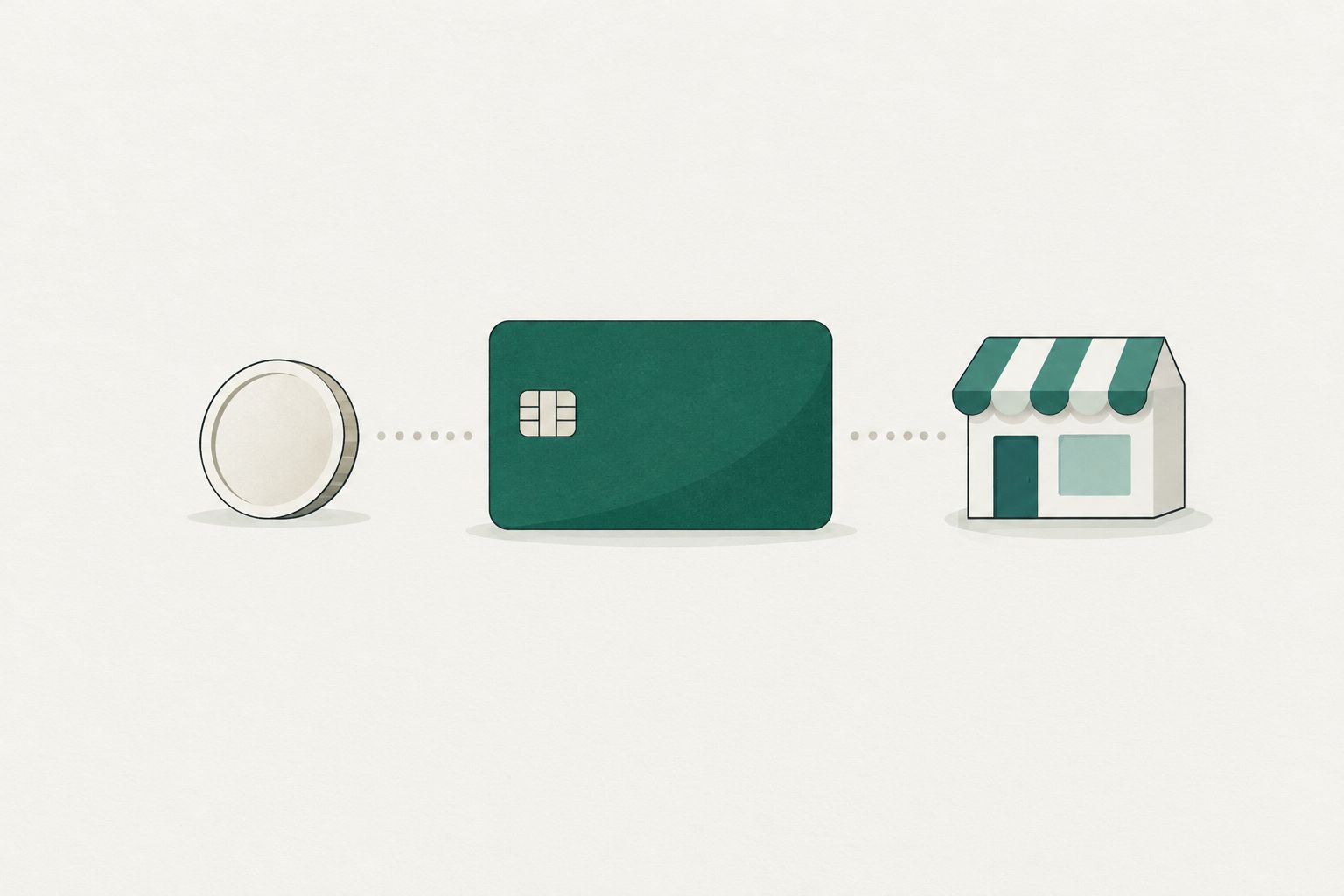
A card payment looks like one step at the till. Behind it there are several parties, and a crypto card adds one more.
- You. You hold crypto or stablecoins and want to spend them.
- The card company. This is the brand you sign up with. It runs the app, the account and the link to your crypto. In industry terms it is often the program manager.
- The issuer. The licensed company that actually issues the card and answers to the card network’s rules. The name on the card and the issuer are often different companies.
- The card network. The card network carries the payment from the shop to the issuer and decides where the card is accepted.
- The shop. It sees a normal card payment in the shop’s own currency.
Usually only you and the card company deal with crypto. For everyone else, it is a regular card.
The path of a payment
Here is what happens from the moment you load the card to the moment the shop is paid.
- You fund the card. You send crypto to the card company, move it from a linked wallet, or approve a spending permission on your own wallet. Some cards also accept a bank transfer.
- The balance is converted. At some point your crypto is sold for the money the shop is paid in. That can happen when you top up or at the moment you pay. More on that below.
- You tap. The shop sends the payment request through the card network to the issuer.
- The issuer approves it. It checks that the card is active and that the balance covers the amount. This takes a moment, and that is all you see.
- The shop is paid in ordinary money. The network settles with the shop in fiat, on its own schedule. The shop never receives crypto and never needs to know the card is a crypto card.
That last point is why a crypto card works anywhere the card network is accepted. It also means the crypto has to be sold somewhere along the way. Spending crypto on a card is, in practice, selling it.
When the conversion happens
There are two common designs, and both are normal.
- At payment. The card keeps your balance in crypto and sells the right amount when you pay. You get the market price of that moment, minus the card company’s margin. The price can move between the moment you decide to buy and the moment the payment is processed.
- At top-up. The card converts when you load it and holds ordinary money. The rate is fixed before you tap, and later price moves no longer change what is on the card. You pay the margin at load time instead.
Neither is better in general. Spending soon after loading makes the difference small. Holding a balance for weeks makes it matter. In both cases the cost is the conversion spread, so it is worth checking where a card says it applies.
Custodial, hybrid and self-custody
Where your crypto sits before the conversion is the question of custody, and cards come in three broad forms.
- Custodial. The card company holds your crypto in an account in its name. You trust it to keep the funds safe and let you withdraw them. Setup and recovery are the easiest.
- Self-custody. The crypto stays in a wallet only you control, and it leaves only when you pay. If the company stops operating, the card stops, but your wallet is still yours. You are responsible for your recovery phrase.
- Hybrid. Something in between. You may move funds into a spending balance, or approve an allowance, before you can pay. For that part of your money the risk looks closer to a custodial card.
Real products blur these lines, so the useful question is: at the moment I tap, whose control is the money under, and for how long before that? Our guide on custodial and self-custody cards goes through it in detail, and the self-custody list shows the cards that keep your crypto in your own wallet.
Where the costs appear
A card can charge you in several places, and not all of them are labelled as fees.
- At top-up. A fee for loading, which can depend on the asset or the network.
- At conversion. The spread between the market price and the price the card uses.
- At the till. A foreign currency charge, when the shop’s currency is not the card’s. See our guide on FX fees and markups abroad.
- Over time. Monthly, inactivity or replacement fees, where an issuer has them.
- At the machine. Cash withdrawals have their own fee and limit.
A card that advertises no fees can still cost you through the rate. That is why we estimate one net cost per card, from verified fees only, and never count a missing fee as zero. See the methodology for how.
Identity checks
A crypto card is a regular payment card, and the companies behind it have to know who their customers are. Expect an identity check, usually before the card is issued, and sometimes again when you want higher limits. A card sold as “no KYC” usually has a lighter check, a low limit, or a check that comes later.
The details are in our guide on KYC for crypto cards. It also shows how many cards sit at each level in our data.
How to pick
Start with what you can get, then compare cost.
- Availability. Cards are open only to some countries, so check yours first.
- Custody. Decide how much risk you want to carry yourself.
- Conversion. Does the card convert when you pay or when you top up, and does that suit how you spend?
- Costs. Look at the fees that apply to your own pattern, such as travel or cash.
The Card Finder does the country filtering and the cost estimate for you. If you only want debit cards, start from the debit list, or browse all crypto cards.
Conditions differ by country and change over time, so confirm the current terms with the card company before you load money.
This guide explains how the products work. It is not financial advice.
Sources
- Visa, VisaNet, Accessed 18 Oct 2026
- European Commission, Crypto-assets and the Markets in Crypto-Assets Regulation (MiCA), Accessed 18 Oct 2026